
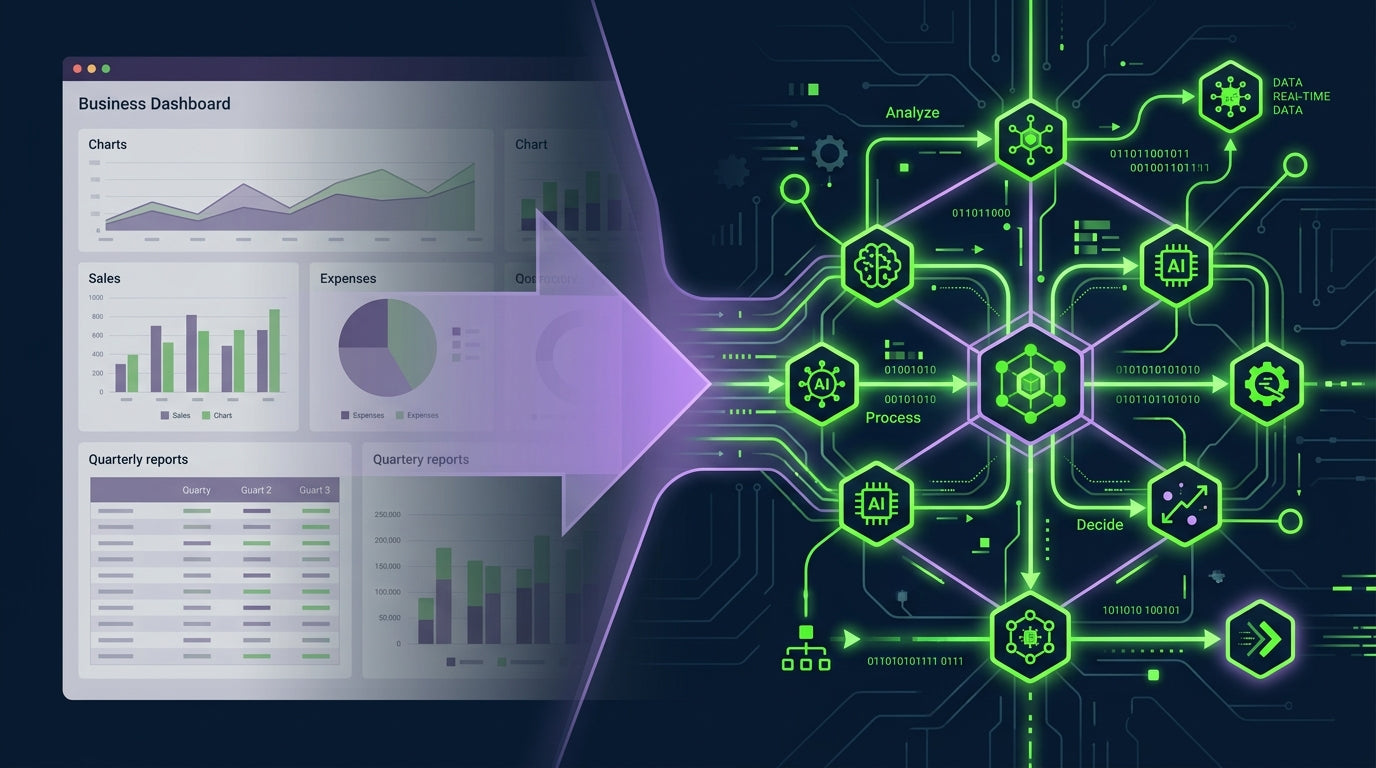
Data science is moving beyond the traditional dashboard.
For years, much of the field revolved around understanding historical information: sales reports, customer trends, performance dashboards, and visualizations that helped businesses understand what had already happened.
That work remains useful. But businesses increasingly need something more.
Instead of asking only “What happened?”, teams want to know “What is likely to happen?” and, more importantly, “What should we do next?”
That shift is changing the skills expected from data scientists in 2026.
The modern data professional needs more than Python, SQL, statistics, and machine learning knowledge. They also need to understand real-time data, automation, deployment, system architecture, and the connection between predictive models and actual business decisions.
This is the rise of proactive analytics: using data and intelligent systems to identify opportunities, anticipate problems, and support or automate decisions before an issue becomes obvious.
From Reporting the Past to Shaping the Next Decision
Traditional analytics can be understood as a progression.
Descriptive Analytics: What Happened?
This is the familiar reporting layer.
A company might examine last month's sales, website traffic, customer acquisition, or inventory levels. Dashboards and reports are excellent tools for answering these questions.
Diagnostic Analytics: Why Did It Happen?
The next step is identifying the reasons behind a result.
For example, a company might discover that sales declined because a competitor launched a promotion, a product went out of stock, or traffic from a particular channel dropped.
Predictive Analytics: What Could Happen Next?
Predictive models use historical and current information to estimate future outcomes.
A business could forecast demand, estimate the probability that a customer will leave, or identify transactions that appear unusual.
Prescriptive Analytics: What Should We Do?
This is where analytics becomes much more directly connected to action.
Instead of simply predicting that a customer is likely to churn, a system could recommend an appropriate retention action. Instead of predicting an inventory shortage, it could suggest how much stock should be reordered.
The supplied research argues that predictive and prescriptive analytics are becoming increasingly important as more routine reporting and analysis become automated.
The key change is simple:
Modern data science isn't only about producing insights. It's about turning those insights into decisions.

Why Traditional Dashboards Aren't Enough
Dashboards aren't disappearing. They remain valuable for monitoring performance and communicating information.
The problem occurs when a dashboard becomes the final destination.
Imagine an operations manager discovers on Monday that a product ran out of inventory over the weekend.
The dashboard did its job. It reported what happened.
But a more advanced system could have noticed that demand was accelerating on Friday, recognized that current inventory wouldn't last through the weekend, and alerted the team before the shortage occurred.
That's the difference between reactive analytics and proactive analytics.
A reactive system waits for the result.
A proactive system watches for signals that indicate what may happen next.
This distinction is particularly important in environments where decisions need to happen quickly. The research highlights examples ranging from supply-chain disruption to personalized customer offers as situations where real-time information can become more valuable than delayed reporting.
The 3 Core Skills Defining Modern Data Science
The foundations of data science haven't disappeared.
Python, SQL, statistics, and machine learning remain essential. What has changed is what comes after those foundations.
The 2026 skill set can be organized around three major areas:
- Real-time data processing
- Decision intelligence
- MLOps and production systems
Together, these skills move data science from analysis toward action.
1. Real-Time Data Processing
A traditional analysis might involve downloading a dataset, cleaning it, running a model, and producing a report.
That workflow is still appropriate for many problems.
But some applications can't wait for a daily or weekly analysis.
Consider:
- Fraud detection
- Financial transactions
- Website personalization
- IoT monitoring
- Dynamic pricing
- Inventory management
- Real-time recommendations
In these scenarios, information can arrive continuously.
A modern data scientist therefore needs to understand how data moves through a system rather than only how to analyze a static dataset.
From Batch Processing to Data Streams
Batch processing handles information in groups. A process might run every hour, every night, or once a week.
Stream processing works with information as it arrives.
That distinction can completely change how an application is designed.
For example, an e-commerce recommendation system could analyze a customer's browsing behavior after the user clicks on several products. Instead of waiting until the next day to update recommendations, the system can respond during the same session.
The research identifies real-time processing as a foundational skill for applications such as fraud detection and dynamic pricing.
For aspiring data scientists, that means learning about concepts such as:
- Event streams
- Data pipelines
- Message queues
- Real-time processing
- Data ingestion
- APIs
- Cloud infrastructure
You don't necessarily need to master every available technology. Understanding how the pieces fit together is more important.
2. Decision Intelligence: Turning Predictions Into Actions
A prediction isn't necessarily useful on its own.
Suppose a machine learning model determines that a customer has a high probability of leaving.
That's useful information—but it doesn't answer the next question:
What should the company do?
Should it send an email?
Offer a discount?
Ask a support representative to contact the customer?
Do nothing?
And if an incentive is offered, how large should it be?
Decision intelligence focuses on connecting predictive information with practical decisions. The research describes this as combining machine learning with business rules, causal reasoning, and optimization to move from prediction to recommended action.
A Simple Example
Imagine an online retailer has a model that predicts customer churn.
A traditional analytics system might produce:
Customer has a 90% estimated probability of churning.
A decision-oriented system goes further:
Customer is at high risk. Offer a targeted retention incentive based on customer value and expected margin.
The second output is much closer to something a business can actually use.
This is an important lesson for data science students:
Don't stop at building the model. Learn what happens after the model produces its result.
3. MLOps: Getting Models Out of the Notebook
A machine learning model can perform beautifully in a notebook and still fail to deliver meaningful value.
Why?
Because production systems have problems that notebooks don't.
Data changes. APIs fail. Infrastructure goes down. Models become less accurate. Dependencies need updating. Security needs to be maintained. New versions have to be tested before deployment.
That's where MLOps, or Machine Learning Operations, comes in.
MLOps applies software engineering and operational practices to the lifecycle of machine learning systems.
The research identifies areas such as Docker-based containerization, CI/CD, cloud infrastructure, monitoring, and data governance as part of the skill set required to deploy and maintain models reliably.
Why MLOps Matters
A production-ready data scientist needs to think beyond:
“Does my model work?”
They also need to ask:
- Can the model be deployed?
- Can it handle new data?
- How will performance be monitored?
- What happens when the input data changes?
- How can the system be updated safely?
- Is sensitive information protected?
- Can the team reproduce the model's results?
- What happens when the model makes an unexpected prediction?
These questions make data science much closer to software engineering than many beginners expect.
The New Data Science Portfolio
If you're learning data science in 2026, your portfolio should demonstrate more than the ability to analyze a downloadable dataset.
A collection of notebooks can show that you understand statistics and machine learning. But employers increasingly benefit from seeing whether you can turn those skills into a working system.
The supplied research makes this distinction by contrasting traditional portfolio projects with more integrated, real-time applications.
Consider the difference.
Instead of a Static E-Commerce Analysis
You could build a recommendation system that responds to user behavior and updates suggestions as customers interact with a website.
Instead of a Historical Stock Dataset
You could create an anomaly-detection prototype that monitors transaction data and identifies unusual activity.
Instead of an Inventory Dashboard
You could build a system that predicts potential shortages and recommends reorder quantities based on incoming sales information.
These projects demonstrate something much broader than modeling.
They show that you understand how data becomes part of an operational system.
How to Document a Strong Data Science Project
A good project isn't finished when the code works.
You also need to explain what you built.
The research recommends documenting projects on GitHub with a detailed README rather than simply uploading source code.
A useful project README could explain:
The Business Problem
What real-world problem does the system solve?
The Data
Where does the information come from? How does it enter the system?
The Architecture
What happens from the moment data arrives to the moment the system produces a result?
The Technology
Explain why you chose the relevant tools, whether that's Python, SQL, Docker, a cloud platform, a streaming system, or an automation service.
The Outcome
What did the system actually accomplish?
If possible, include measurable results.
This turns a GitHub repository into a miniature case study rather than simply a code archive.
Automation Is Becoming Part of the Data Scientist's Toolkit
One of the most important themes in the research is that data science increasingly overlaps with automation.
A model can predict something, but another system needs to act on that prediction.
That could mean:
- Sending an alert
- Updating a CRM
- Triggering an inventory workflow
- Adjusting a recommendation
- Creating a support ticket
- Calling an external API
- Routing a customer to a different experience
This is where automation platforms, APIs, and workflow tools become useful.
And it doesn't always require writing every component from scratch.
Low-code and no-code platforms can help connect services and orchestrate workflows, while Python and other programming languages can handle the parts requiring custom logic. The research specifically highlights automation as a skill that connects predictive models to practical business processes.
The goal isn't to replace programming with visual workflow builders.
It's to understand which parts of a system need code and which parts can be assembled efficiently with existing tools.
A Practical Learning Path for Data Science in 2026
You don't need to learn every new framework at once.
A better approach is to build skills progressively.
Step 1: Master the Fundamentals
Start with:
- Python
- SQL
- Statistics
- Data manipulation
- Machine learning fundamentals
- Model evaluation
These remain foundational. The research explicitly describes Python, SQL, statistics, and machine learning as essential starting points.
Don't rush past these skills in pursuit of the newest AI tool.
If you don't understand the fundamentals, advanced tools can make it easier to produce something without making it easier to understand what you've produced.
Step 2: Learn to Connect Systems
Once the fundamentals are solid, move from analysis toward integration.
Learn how to:
- Work with APIs
- Build data pipelines
- Process information automatically
- Connect different services
- Trigger actions based on model output
- Handle errors and unexpected inputs
This is where a data science project begins to resemble a real application.
Step 3: Learn Deployment
Take a model you've built and make it usable.
For example, you might:
- Train a model.
- Wrap it in an API.
- Deploy it to a cloud environment.
- Feed it new data.
- Return predictions to an application.
- Monitor its performance.
The research recommends gaining hands-on experience with cloud environments such as AWS, Google Cloud, or Azure and building simple end-to-end applications rather than stopping at theoretical exercises.
Step 4: Build a Real-Time Project
This is where the previous skills come together.
Create something that receives data continuously and responds to it.
It doesn't have to be a massive production system.
A small but functional project can demonstrate:
Data → Processing → Prediction → Decision → Action
That workflow is far more representative of proactive analytics than a static notebook.
Step 5: Add Monitoring and Iteration
Finally, learn what happens after deployment.
Track whether the system is behaving as expected. Test new versions. Watch for changes in the incoming data. Improve the model and workflow as you learn more.
This is where MLOps becomes practical rather than theoretical.
What Should You Actually Learn?
It's tempting to build a huge checklist of technologies:
Python. SQL. Kafka. Docker. AWS. Kubernetes. TensorFlow. PyTorch. Spark. Airflow. And then another 47 tools someone mentioned in a Reddit comment at 2 a.m.
Don't.
The more valuable skill is understanding principles and systems.
You should be able to explain:
- How data enters a system
- How it is cleaned and transformed
- How a model consumes it
- How predictions are evaluated
- How predictions influence decisions
- How actions are triggered
- How the system is deployed
- How performance is monitored
- How the system is updated safely
Once you understand those ideas, learning a new tool becomes much easier.
What Employers Can See From a Strong Project
A well-designed project can demonstrate several skills simultaneously.
For example, a real-time fraud detection application might show that you understand:
- Data ingestion
- Feature engineering
- Machine learning
- Anomaly detection
- APIs
- Real-time processing
- Cloud deployment
- Monitoring
- Automation
- Documentation
That's much more informative than a résumé line that simply says:
“Completed a machine learning project.”
The project tells a story.
It shows how you think.
And that's increasingly important as AI tools make it easier to generate pieces of code. The differentiating skill becomes the ability to understand the larger system and make good technical decisions.
Data Science Is Becoming More About Systems Thinking
The biggest change in data science isn't that dashboards are suddenly useless or that traditional analysis has disappeared.
It's that the field is expanding.
A data scientist may now need to think simultaneously about:
Data + Models + Software + Automation + Business Decisions
That requires systems thinking.
Suppose an organization wants to reduce customer churn.
The old approach might involve analyzing historical churn and producing a report.
A more modern approach could involve:
- Streaming customer activity into a data pipeline.
- Updating a churn prediction as behavior changes.
- Combining the prediction with customer value and business rules.
- Selecting an appropriate intervention.
- Triggering the intervention automatically.
- Measuring the result.
- Feeding the outcome back into the system.
Now the data scientist isn't merely reporting churn.
They're helping build a system that responds to it.
That's the fundamental shift toward proactive analytics.

Final Thoughts
Data science in 2026 still requires strong foundations in Python, SQL, statistics, and machine learning. Those skills aren't going away.
What is changing is the distance between analysis and action.
The strongest data professionals increasingly need to understand how information moves through real-time systems, how predictions can inform decisions, and how machine learning models can be deployed and maintained reliably.
That means the most useful learning path isn't necessarily the one with the longest list of technologies.
It's the one that teaches you how to build something that works from beginning to end.
Start with the fundamentals. Learn automation. Build real-time workflows. Deploy models. Monitor them. Document your projects. Most importantly, solve problems that resemble the ones organizations actually face.
The future of data science isn't simply about predicting what comes next.
It's about building systems capable of responding intelligently when it does.
Share:
donk vs. ZywOo in 2026: Who Is CS2’s Best Player?
Fortnite V-Bucks Changes in 2026: What the Battle Pass Update Means