
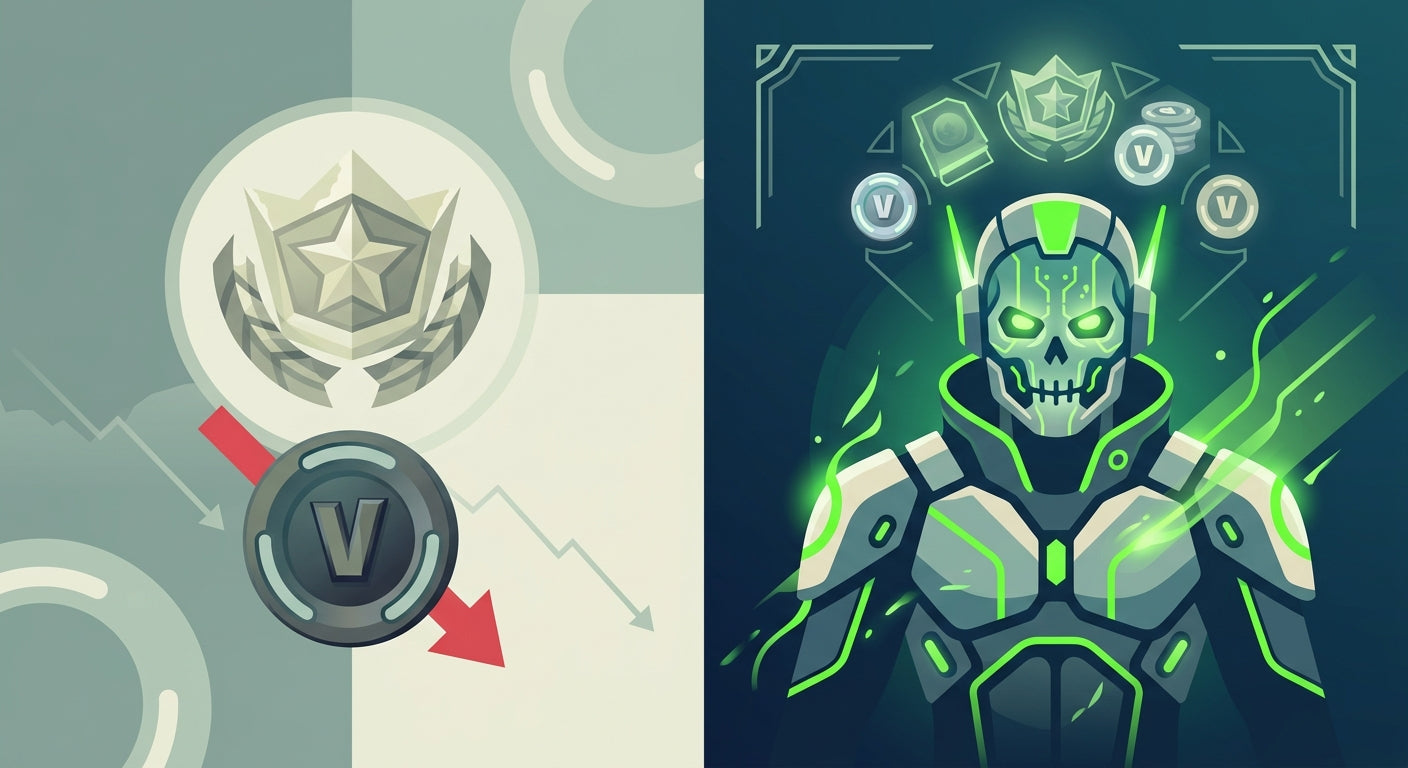
Fortnite's in-game economy looks different in 2026.
Starting March 19, 2026, Epic Games changed how players earn V-Bucks through the Battle Pass and how many V-Bucks they receive from several direct-purchase packs. The result is a significant shift for players who have traditionally used the Battle Pass to fund future seasons while keeping some V-Bucks left over for Item Shop cosmetics.
The biggest change is easy to understand:
The Battle Pass now costs 800 V-Bucks and can return up to 800 V-Bucks.
Previously, the pass could cost around 950–1,000 V-Bucks while offering up to 1,500 V-Bucks in rewards. That meant completing the pass could leave dedicated players with additional currency to spend elsewhere. The new structure removes that surplus.
At the same time, several V-Bucks bundles provide fewer V-Bucks for the same real-money prices.
So, is this simply a price adjustment, or does it represent a bigger change to the way Fortnite's economy works?
Here's what players need to know.
What Changed With Fortnite's Battle Pass?
The 2026 Battle Pass has a lower entry price, but the potential V-Bucks return has also been reduced.
The basic comparison is:
| Previous Battle Pass | 2026 Battle Pass | |
|---|---|---|
| Cost | 950–1,000 V-Bucks | 800 V-Bucks |
| Maximum V-Bucks earned | Up to 1,500 | Up to 800 |
| Potential surplus | Up to several hundred V-Bucks | None |
The exact significance is in the final column.
Under the previous model, a player who completed the pass could potentially recover the cost and have currency remaining for Item Shop purchases.
The new model is essentially break-even.
Spend 800 V-Bucks on the pass, complete it, and you can earn those 800 V-Bucks back. The pass can therefore help fund the next season, but it no longer acts as a source of extra V-Bucks for other purchases.

Cheaper to Enter, Less Valuable as a Currency Generator
There's an interesting trade-off here.
The new Battle Pass is cheaper to purchase upfront. That could make it easier for someone to participate in the seasonal content without spending as many V-Bucks initially.
But its role has changed.
Previously, completing the pass could contribute toward both future Battle Pass access and Item Shop spending.
Now, its V-Bucks component is primarily about maintaining access to future passes.
That makes the cosmetics and other content included in the pass much more important when deciding whether it's worthwhile.
Fortnite Also Changed V-Bucks Bundle Values
The Battle Pass isn't the only part of the economy that changed.
Epic also adjusted the number of V-Bucks included in several direct-purchase bundles while keeping the listed dollar prices in the supplied research unchanged.
The comparison looks like this:
| Price | Previous V-Bucks | 2026 V-Bucks |
|---|---|---|
| $8.99 | 1,000 | 800 |
| $22.99 | 2,800 | 2,400 |
| $36.99 | 5,000 | 4,500 |
| $89.99 | 13,500 | 12,500 |
The change is especially noticeable with the $8.99 option, where the supplied material describes roughly a 20% reduction in V-Bucks.
This matters because players who previously relied on direct V-Bucks purchases now receive less currency for the same listed price.
In practical terms, the purchasing power of each dollar spent directly on V-Bucks has decreased under the figures provided in the research.
What Does This Mean for Item Shop Skins?
This is where the change becomes more noticeable for players who spend V-Bucks primarily on cosmetics.
Imagine a player who used to complete every Battle Pass and finish the season with enough extra V-Bucks to occasionally purchase an Item Shop skin.
Under the new system, that surplus disappears.
The player can still complete the Battle Pass and recover the 800 V-Bucks needed for another season, assuming they earn the full reward amount. But buying an additional cosmetic now requires another source of V-Bucks.
That creates a much clearer separation between:
Battle Pass spending
and
Item Shop spending
The two are no longer as easily funded by the same pool of earned currency.
Why Cosmetic Value May Feel Different
When an in-game currency becomes harder to accumulate through gameplay, players may become more selective about what they purchase.
A skin that once seemed like an easy impulse purchase can feel more expensive when buying it means giving up progress toward another cosmetic.
This doesn't necessarily change the listed price of the skin.
It changes the opportunity cost of buying it.
For players who don't subscribe to Fortnite Crew, that distinction could become particularly noticeable. The research suggests that scarcity of V-Bucks may also affect how players perceive exclusive cosmetics and other premium content.
Why Fortnite Crew Matters More Now
The biggest strategic consequence of the changes may be the increased importance of Fortnite Crew.
The supplied material argues that reducing the V-Bucks surplus from the Battle Pass makes the subscription more attractive to highly engaged players.
The reasoning is straightforward.
If a player regularly buys Battle Passes, wants additional V-Bucks, and participates in several parts of the Fortnite ecosystem, a subscription that combines multiple benefits can become more appealing than purchasing individual components separately.
According to the supplied research, the $11.99 monthly Crew subscription includes:
- The current Battle Pass
- 800 V-Bucks per month
- An exclusive Crew Pack outfit and related cosmetics
- Access to additional passes associated with other Fortnite experiences
- A Rocket League-related premium benefit
That makes the subscription more than simply a monthly V-Bucks purchase.
It's a bundle of access and content.
Is Fortnite Crew Worth It in 2026?
There's no universal answer.
It depends heavily on how often you play and what you normally spend money on.
For Frequent Fortnite Players
Crew may make more sense if you:
- Play Fortnite regularly
- Plan to complete multiple Battle Passes
- Want the monthly V-Bucks allocation
- Enjoy exclusive Crew cosmetics
- Play several Fortnite-related modes
- Would otherwise spend money on some of the included content
For this type of player, bundling several benefits into one subscription can make the value proposition more attractive.
For Casual Players
The calculation is different if you only play occasionally.
A player who logs in a few times each month may not use enough of the included content to justify another recurring subscription.
If you don't care about exclusive cosmetics, rarely complete passes, or don't participate in the other included experiences, paying every month may not be particularly useful.
The research similarly distinguishes between highly engaged players and casual players when considering whether Crew provides enough value to justify the cost.
The lesson is simple:
Don't evaluate the subscription based on everything it includes. Evaluate it based on how much of that content you would actually use.
The Battle Pass Has Become More About Cosmetics
There's another subtle change worth considering.
When the Battle Pass could generate a V-Bucks surplus, part of its appeal came from its economic return.
A player could think:
I'll buy this pass, complete it, recover the currency, and have some left over.
That's no longer the same proposition.
The 2026 Battle Pass is better viewed as a content purchase that can fund the next Battle Pass.
That puts greater emphasis on the actual content.
If you like the outfits, emotes, accessories, progression rewards, and other seasonal items, the pass may still be attractive.
If you were mainly interested in the V-Bucks return, the new structure is much less compelling.
How Should Players Manage Their V-Bucks?
The new system makes budgeting more important.
If you're a non-Crew player and intend to keep buying Battle Passes, one straightforward strategy is to treat your earned 800 V-Bucks as reserved currency for the next pass.
Don't think of it as disposable Item Shop money.
Once that reserve is spent, you may need to purchase additional V-Bucks if you want another cosmetic.
The research specifically recommends prioritizing the earned V-Bucks toward the next Battle Pass and looking to other available methods or events for additional currency where applicable.
A Simple V-Bucks Budget
If you're trying to make your currency last, consider separating purchases into three categories:
1. Pass reserve
Keep enough V-Bucks available for your next Battle Pass.
2. Favorite cosmetics
Only spend additional currency on skins or bundles you genuinely want.
3. Optional purchases
Treat impulse purchases as the first category to cut when your balance gets low.
This approach won't create more V-Bucks, but it can prevent the common problem of spending everything early in a season and having nothing left when something you really want appears later.
What About Exclusive Crew Skins?
The new economy may also affect how players perceive subscription-exclusive cosmetics.
The research points to the March 2026 Skull Raider as an example of a Crew Pack skin tied to a particular subscription period rather than an ordinary Item Shop purchase.
That creates a different kind of value.
An Item Shop cosmetic is generally something a player can consider buying whenever it becomes available and they have enough V-Bucks.
A Crew Pack cosmetic is connected to the subscription experience and a specific period.
For collectors, that distinction can make subscription cosmetics feel more significant than their raw V-Bucks value suggests.
Of course, whether an exclusive cosmetic is personally worth paying for depends entirely on the individual player.
Why Epic Might Prefer a Subscription Model
The economic changes also make sense when viewed from a business perspective.
A player who occasionally purchases V-Bucks creates irregular revenue.
A subscriber creates a more predictable recurring payment.
That distinction matters for any live-service game.
Fortnite has also expanded beyond its original battle royale identity. The supplied research points to the broader ecosystem around LEGO Fortnite, Rocket Racing, Fortnite Festival, and the creator economy as part of Epic's explanation for its pricing changes and the game's expanding universe.
A subscription can bundle these experiences together and encourage players to spend more time inside the broader Fortnite ecosystem.
From the player's perspective, that means Crew becomes easier to justify if they regularly use multiple parts of the platform.
From Epic's perspective, subscriptions can create a more predictable revenue model.
Both sides therefore have an incentive to see value in the bundle—although individual players should still decide based on their own usage.
Is This Really a "V-Bucks Nerf"?
Calling it a V-Bucks nerf is understandable from the player's perspective.
But the change is broader than simply reducing one reward.
Several things happened at once:
- The Battle Pass became cheaper.
- The maximum V-Bucks reward dropped.
- The previous surplus disappeared.
- Several direct-purchase bundles provide fewer V-Bucks at the listed prices in the research.
- Fortnite Crew became comparatively more attractive to highly engaged players.
That's better understood as a restructuring of Fortnite's economy than a single isolated nerf.
The important question isn't just whether players receive fewer V-Bucks.
It's how the different purchasing paths now interact.
What Should Casual Players Do?
If you only play Fortnite occasionally, there's no reason to assume you need a subscription simply because the economy changed.
Start with the content you actually want.
If you like the current Battle Pass and expect to play enough to complete it, the 800-V-Buck price may be reasonable for you.
If you're mostly interested in one Item Shop skin, compare the cost of that purchase against the amount of playtime and enjoyment you'll get from it.
And if you don't care about cosmetics at all, you may not need to spend anything.
The most important thing is not to let the new structure create artificial pressure to subscribe.
A subscription is valuable when you use its benefits—not simply because it exists.
What Should Dedicated Players Do?
For players who participate heavily in Fortnite, the calculation deserves more attention.
Make a list of what you normally purchase during a season:
- Battle Pass
- Item Shop cosmetics
- Crew cosmetics
- Other Fortnite-related passes
- V-Bucks
- Other premium content
Then compare that spending pattern against the benefits included with Crew.
If you already spend regularly on several of those items, the subscription may provide a more efficient way to organize your spending.
If you mainly purchase a Battle Pass and rarely buy anything else, the decision is less obvious.
The key is to compare actual usage, not theoretical value.
The Bigger Lesson for Fortnite Players
The 2026 changes are significant because they alter the relationship between playing Fortnite and funding future purchases.
The old system gave dedicated players a way to turn Battle Pass progression into a larger pool of V-Bucks.
The new system is much more self-contained.
The Battle Pass can essentially sustain itself, but additional spending is more clearly separated from that progression.
That makes the Fortnite Crew subscription more relevant, while also making direct V-Bucks purchases more consequential for players who want Item Shop cosmetics.
For players, the practical response is straightforward:
Know what you actually value, set a V-Bucks budget, and don't confuse a lower Battle Pass price with the same overall economic value.
Final Thoughts
Fortnite's 2026 V-Bucks changes aren't simply about one number going up or down.
The Battle Pass is cheaper at 800 V-Bucks, but its V-Bucks reward has also been reduced to 800. Several direct-purchase bundles now provide fewer V-Bucks at the listed prices covered by the research. And Fortnite Crew has become a more prominent part of the game's premium value proposition.
For casual players, the best choice may be to simply buy what they genuinely want and ignore the rest.
For dedicated players, Crew may make more financial sense if they regularly use enough of its benefits.
Either way, the biggest change is psychological as much as economic: the Battle Pass is no longer something players can rely on to generate extra V-Bucks for the Item Shop.
It's now primarily a way to access seasonal content and recover the currency needed for the next pass.
That makes every additional V-Buck purchase a little more deliberate—and makes the question of what Fortnite content is actually worth paying for more important than ever.
Share:
Data Science in 2026: The Skills Behind Proactive Analytics
AI Upskilling in 2026: How to Build Skills That Deliver Business ROI